Keeping surface water away from the house
Yard drainage and French drains in Tigard
A yard that holds water beside the house keeps the foundation wet for days after the rain stops. Fixing the yard is often cheaper than fixing the basement.
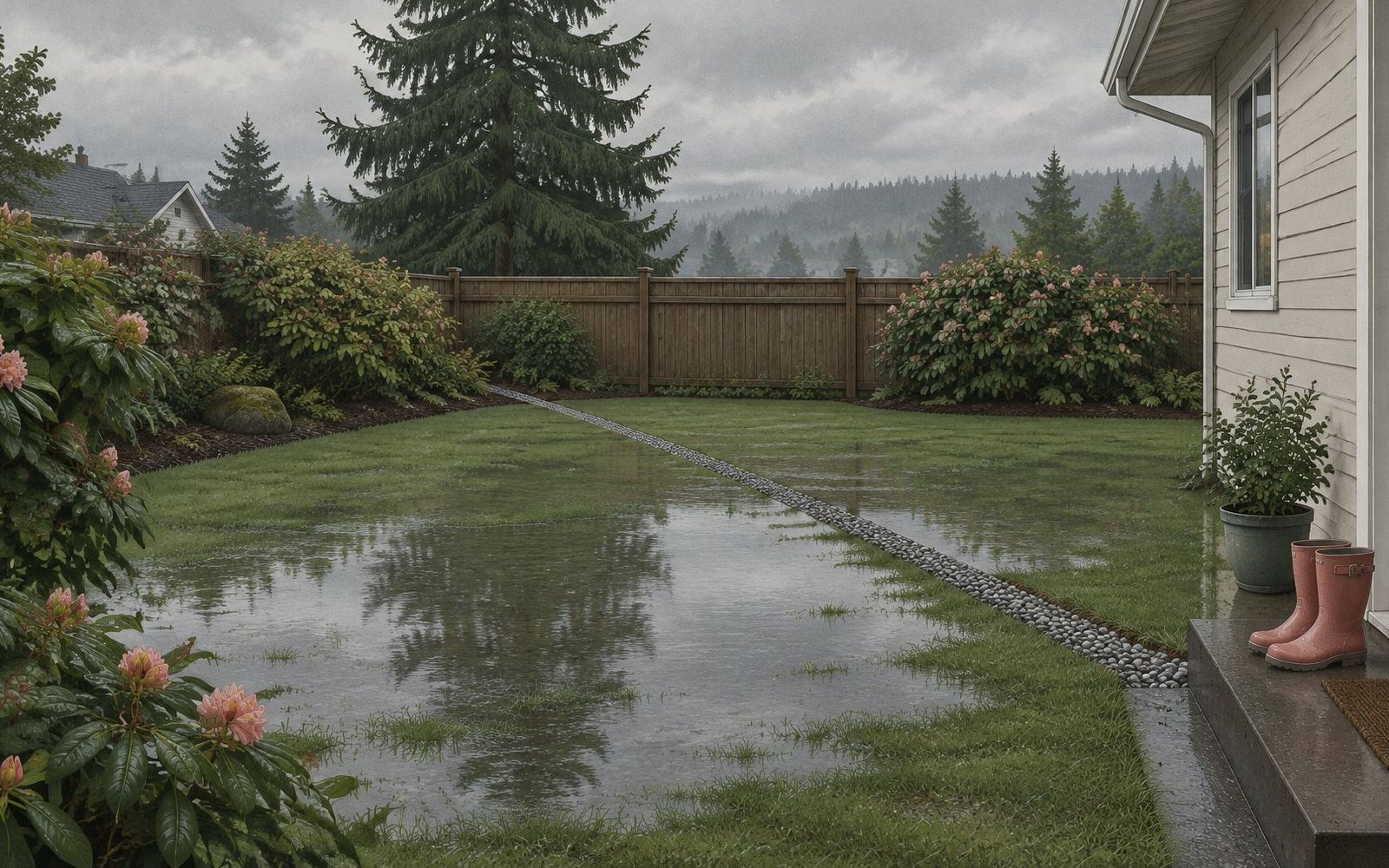
How yard water becomes house water
Soil against a foundation is looser than the ground around it, because it was dug out and put back when the house was built. Water finds it and sinks straight down the wall.
Add a roof that sheds its rain at the corners and a lawn that tilts toward the house, and the foundation becomes the low point of the lot.
The fixes, from light to heavy
Regrading
Soil is added or cut so the ground falls away from the walls. It is simple, and it has to be kept clear of the siding.
Piping the downspouts
Each downspout is connected to a solid buried pipe that runs to a safe outlet. This takes roof water out of the equation.
A French drain
A trench with perforated pipe in washed stone. It intercepts water moving through the top layer of soil and leads it away.
Catch basins
Grated boxes at low spots, joined by solid pipe. They deal with water on the surface where a French drain deals with water in the ground.
A dry well or rain garden
A place for the piped water to soak in, set well away from any foundation. It only works where the soil drains.
What a French drain can and cannot do
It works along a line. Laid across the uphill side of a house it cuts off water sliding toward the wall. Laid in a soggy lawn it dries a strip either side of the trench.
It needs fall and an outlet. A trench with no slope, or one that ends nowhere, fills up and becomes a long pond under the grass.
It clogs if soil washes into the stone. Fabric around the stone and a cleanout at the upper end let it be flushed.
Tigard's rules on private drains
Clean Water Services, the district that runs the public storm system here, says drains on an individual lot are the owner's to maintain. Its fact sheet names French drains and rain gardens as examples.
The same sheet says a private drainage system needs approval, and that the district will not referee water running from one lot to the next. Point the outlet at your own ground or at an approved connection.
Trenching needs an 811 locate, and 811 does not mark your own irrigation, lighting or drain lines. The Tigard guide sets out the steps.
Ask the company
- Where is the outlet, and how much fall is there between the house and it?
- Is the downspout pipe solid and separate from the perforated drain?
- Where are the cleanouts?
- What happens to the lawn and beds along the trench, and who reseeds?
Yard drainage questions
My neighbor's yard drains into mine. Who deals with that?
The two of you. Clean Water Services encourages owners to work it out together and suggests a lawyer who knows drainage law where that fails.
Will a French drain keep my crawl space dry?
It can cut down the water arriving from one side. If water still stands under the house, the crawl space needs its own drain and pump.
Ready to have someone look at it?
Describe what you are seeing and where in the house it is. The company on the phone will tell you whether it is work they take on and when they could come out.
Get a waterproofing company on the phone
For homeowners with water coming into a basement or crawl space, or a yard that drains toward the house.
Call (503) 555-0120Calls can be recorded. Read how the referral is paid for and what happens to your details.